Travel / Kyoto Prefecture
Fushimi Inari Taisha
The head shrine of approximately 30,000 Inari shrines across Japan. One of Kyoto's most visited pilgrimage sites, renowned for the 'Senbon Torii'—a seemingly endless tunnel of vermilion torii gates—and the Inari-yama mountain trail through the sacred grounds. Free admission, open 24 hours, and consistently ranked as Japan's most popular destination among international visitors.
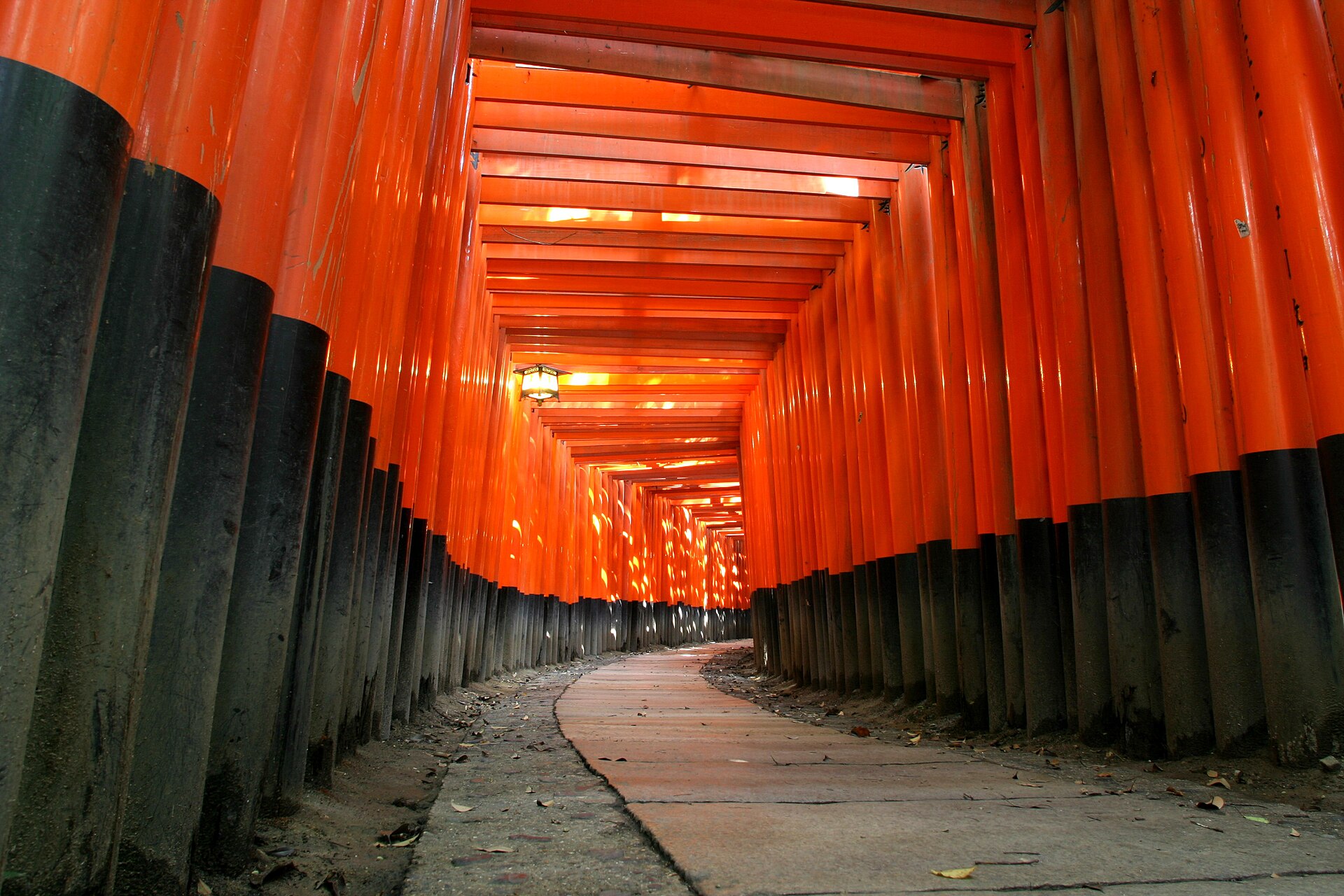
Photo: Paul Vlaar / CC BY-SA 3.0
- Access
- Directly outside JR Nara Line 'Inari' Station (approx. 5 minutes from Kyoto Station) / Keihan Main Line 'Fushimi Inari' Station, 5-minute walk east
- Duration
- Approx. 30–60 minutes for the main grounds only; approx. 2 hours including the full Inari-yama mountain trail
- Price
- Free admission
- Hours
- Open at all times (24 hours)
- Closed
- Never closed
- Source: 交通アクセス|伏見稲荷大社 (confirmed July 19, 2026)
- Source: 伏見稲荷大社 | スポット一覧 | 京都府観光連盟公式サイト (confirmed July 19, 2026)
Prices and hours may change. Please check the official site before you go.
The 'Senbon Torii'—10,000 Gates in a Row, Walking the Vermilion Corridor
What brought Fushimi Inari Taisha its worldwide fame is the 'Senbon Torii'—a corridor of torii gates standing so close together they form an unbroken tunnel. 'Senbon' literally means 'one thousand,' but it is simply an expression for a great number; in reality, approximately 10,000 torii line the trails of Inari-yama. The custom of donating torii gates spread during the Edo period, with individuals and companies fulfilling vows or offering prayers for wishes to be granted, a tradition that has continued for generations. The name of the donor and the date of dedication are carved into each gate's pillars—look closely and you'll find the names of major corporations alongside those of private individuals, each carrying its own quiet intention. The stretch most commonly referred to as the 'Senbon Torii' is the section along the path to Okusha (Oku-no-in), past the main hall, where the gates split into two parallel lanes. The gates are painted in a deep red-orange known as 'Inari vermilion,' and walking through them blocks out the surrounding light, enveloping you in a sense of otherworldliness. Early morning draws few visitors, and the soft morning light filtering through creates an almost dreamlike atmosphere you can enjoy nearly all to yourself. Midday brings lively crowds, yet the light playing through the rows of gates holds its own particular charm—a spot that offers a different face depending on when you visit.
Head Shrine of 30,000 Across Japan—1,315 Years of History and Faith Since 711
Fushimi Inari Taisha is said to have been founded in 711 (the 4th year of the Wadō era), giving it a history of over 1,315 years as of 2026. It serves as the head shrine of the approximately 30,000 Inari shrines found throughout Japan, and is also the birthplace of 'Inari faith,' which venerates five deities. The principal deity, Ukanomitama-no-Ōkami, was originally a god of agriculture and a bountiful harvest, but from the Heian period onward was increasingly revered as a deity of commercial prosperity and industrial development. The current main hall was rebuilt in 1499 during the Muromachi period and is designated as an Important Cultural Property by the Japanese government. The approach leading through the rōmon gate, outer worship hall, and inner worship hall to the main hall is lined with architecture of the highest ceremonial distinction. Throughout the precincts, statues of foxes (kitsune)—regarded as the divine messengers of the Inari faith—can be found everywhere, long cherished as symbols of this belief. It is this layered history, in no small part, that draws a steady stream of worshippers throughout the year.
The Inari-yama Mountain Trail—A Mystical 2-Hour Walk to the Summit
Stopping at the main hall's precincts alone would mean missing much of what Fushimi Inari Taisha has to offer. From behind the main hall, the mountain trail known as 'Oyama Meguri' winds up Inari-yama (233 m / 764 ft), with small shrines and vermilion torii gates appearing throughout the forest at every turn. The entire mountain is considered sacred ground, and the course to Ichinohmine (the summit) covers approximately 4 km in total. Along the way, 'Yotsutsuji'—a crossroads at around 150 m in elevation—offers a panoramic view over the Kyoto basin and serves as a popular rest spot for many visitors. The full round-trip circuit including the summit takes approximately 2 hours (also listed as '120 minutes' on the Kyoto Tourism Federation's official website). The mountain paths are well-maintained, but involve continuous slopes and steps, so comfortable walking shoes—at minimum sneakers—are recommended. The forest canopy keeps things relatively cool even in summer, though some sections of the trail have limited street lighting, making the nighttime circuit better suited to those already familiar with the route.
Visiting Tips—Free, 24 Hours, and Early Morning Is the Sweet Spot
The grounds of Fushimi Inari Taisha and the Inari-yama trail are free to enter and accessible 24 hours a day, every day of the year. Visitors from Japan and abroad arrive throughout the year, but the area around the Senbon Torii becomes particularly crowded during the day (roughly 10:00 AM–4:00 PM), making it difficult even to take a photo. Early morning is therefore the ideal time to visit. Between 6:00 and 8:00 AM the crowds are thin, and you can take your time enjoying the interplay of light and shadow through the gates. The most convenient access is via JR Nara Line 'Inari Station'—step out of the ticket gates and the great torii gate is right in front of you. It's just about 5 minutes from Kyoto Station, making it exceptionally well located. The shrine is also a 5-minute walk east from Keihan Main Line 'Fushimi Inari Station.' The use of public transportation is officially encouraged; visitors arriving by car will find surrounding roads heavily congested, especially on weekends and public holidays. Omikuji (fortune slips) and votive items can be purchased at the shrine's offering offices within the grounds. Rest areas and tea houses for visitors are also available on the grounds, providing a place to relax after your worship.

How this character would spend the day
Rena's Route: Early Morning Start, Conquer the Full Mountain
- 06:30Arrive at JR Inari Station. The great torii gate is right in front of you as you exit the ticket gates. While the crowds are still thin, walk from the rōmon gate through the Senbon Torii. The morning light makes the vermilion of the gates especially vivid.
- 07:00At Okusha (Oku-no-in), try the 'Omokaru-ishi' (heavy/light stones) to divine whether your wish will be granted. The legend goes that if the stone feels lighter than you imagined when you lift it, your wish will come true—a popular stop for worshippers.
- 07:20Begin the Inari-yama mountain trail. Start climbing the tree-lined path, pausing to pay your respects at each small shrine along the way.
- 08:10Arrive at Yotsutsuji. Take a short rest while taking in the panoramic view over the Kyoto basin. If you have the energy, continue to the summit (Ichinohmine) for an additional round-trip of about 40 minutes.
- 09:15After descending, have breakfast at one of the tea houses along the approach—inari-zushi (fox sushi) or kitsune udon are the local favorites. Head back to Kyoto Station from JR Inari Station, leaving the rest of the morning free for your next destination.