Travel / Nara Prefecture
Nara Park
A vast historic park emblematic of Nara, home to approximately 1,325 wild deer designated as a National Natural Monument. Four UNESCO World Heritage Sites—including Todai-ji, Kasuga Taisha, and Kofuku-ji—are located adjacent to the park, which itself is open 24 hours a day, year-round, free of charge.
- Access
- Approx. 8-minute walk from Kintetsu Nara Station. Approx. 20-minute walk from JR Nara Station, or approx. 7 minutes by Nara Kotsu Bus (City Loop, Outer Route) to the "Kencho-mae" stop.
- Duration
- Approx. 2–4 hours (allow a half day if including major sites such as Todai-ji and Kasuga Taisha)
- Price
- The park itself is free and open 24 hours. Separate admission fees apply for Todai-ji's Great Buddha Hall, Kasuga Taisha's inner shrine special visit, Mt. Wakakusa entry, and other individual facilities.
- Hours
- 24 hours, year-round (park grounds)
- Closed
- None
- Source: 奈良公園 | 奈良市観光協会公式サイト (confirmed August 9, 2026)
- Source: 奈良公園の鹿 | 奈良公園クイックガイド(奈良県公式) (confirmed August 9, 2026)
Prices and hours may change. Please check the official site before you go.
A Great Park of History and Nature—Free to Explore, Around the Clock
Nara Park, spread across Nara City in Nara Prefecture, is one of Japan's most celebrated historic parks, encompassing four UNESCO World Heritage Sites: Todai-ji, Kasuga Taisha, Kofuku-ji, and Kasugayama Primeval Forest. Covering a total area of approximately 660 hectares, the park offers a rich variety of landscapes—from manicured grass lawns to dense primeval forest—where nature and historic monuments coexist side by side. Entry to the park itself is free, 24 hours a day, 365 days a year. Its accessibility is another draw: just an 8-minute walk from Kintetsu Nara Station, or a 7-minute bus ride on the Nara Kotsu City Loop (Outer Route) from JR Nara Station, alighting at "Kencho-mae." In the morning, a quiet stillness fills the air as deer graze through the white mist; by midday, tourists and locals mingle in a lively bustle; and at dusk, the silhouette of the Great Buddha Hall is silhouetted against a crimson sky. This park, which shifts its mood throughout the day, can all be enjoyed without an entry fee. School excursion students, international visitors, and local residents walking their dogs all coexist as equal inhabitants of the park—and that open, welcoming atmosphere is itself a defining quality of Nara Park.
Meeting Approx. 1,325 Wild Deer Up Close
No account of Nara Park would be complete without mentioning its wild deer, designated as a National Natural Monument. A survey conducted in July 2024 (Reiwa 6) counted 313 males, 798 females, and 214 fawns—1,325 deer in total living within the park. These are not domesticated animals; they live entirely as wild creatures, feeding on grass and vegetation. As a result, it is an everyday sight to see a deer lounging on the lawn while people casually walk by just a few feet away. Inside the park, you can purchase "shika senbei" (deer crackers) and feed them directly by hand. The crackers are made from rice bran and wheat flour, with no added sugar or salt. One important tip: if you hold the cracker out but make the deer wait too long, it may headbutt you out of impatience—so the rule is to offer it right away. Turning your back or holding the cracker up high are also things to avoid. It takes a little getting used to, but once you do, you start to notice each deer has its own personality. In early summer when fawns are born, the Nara Deer Preservation Foundation holds a "Fawn Viewing" event, and the sight of wobbly little fawns toddling around is sure to warm your heart.
Todai-ji, Kasuga Taisha—World Heritage Sites Within Walking Distance
Within walking distance of Nara Park, the major temples and shrines that make up the World Cultural Heritage site "Historic Monuments of Ancient Nara" are clustered together. Todai-ji's Great Buddha Hall is one of the largest wooden structures in the world, housing the Great Buddha (Vairocana Buddha), which stands approximately 15 meters tall. Many visitors say that its overwhelming scale doesn't fully come through in photographs. Separate admission is required to enter the Great Buddha Hall. Kasuga Taisha, founded in 768 (the second year of Jingo-Keiun), is famous for the approximately 1,000 hanging lanterns suspended from its corridor and the roughly 2,000 stone lanterns lining its approach—together creating a landscape uniquely characteristic of Nara. (A fee applies for a special visit to the inner shrine.) Kofuku-ji's Five-Story Pagoda is a beloved symbol of Nara; the view of the pagoda's reflection in the adjacent Sarusawa Pond is a classic composition that draws photographers from near and far. All of these are within 10 to 30 minutes on foot from the park's lawn, making Nara Park a remarkable base from which to visit one World Heritage Site after another.
Mt. Wakakusa, Tobihino, Ukimido—The Many Faces of the Park
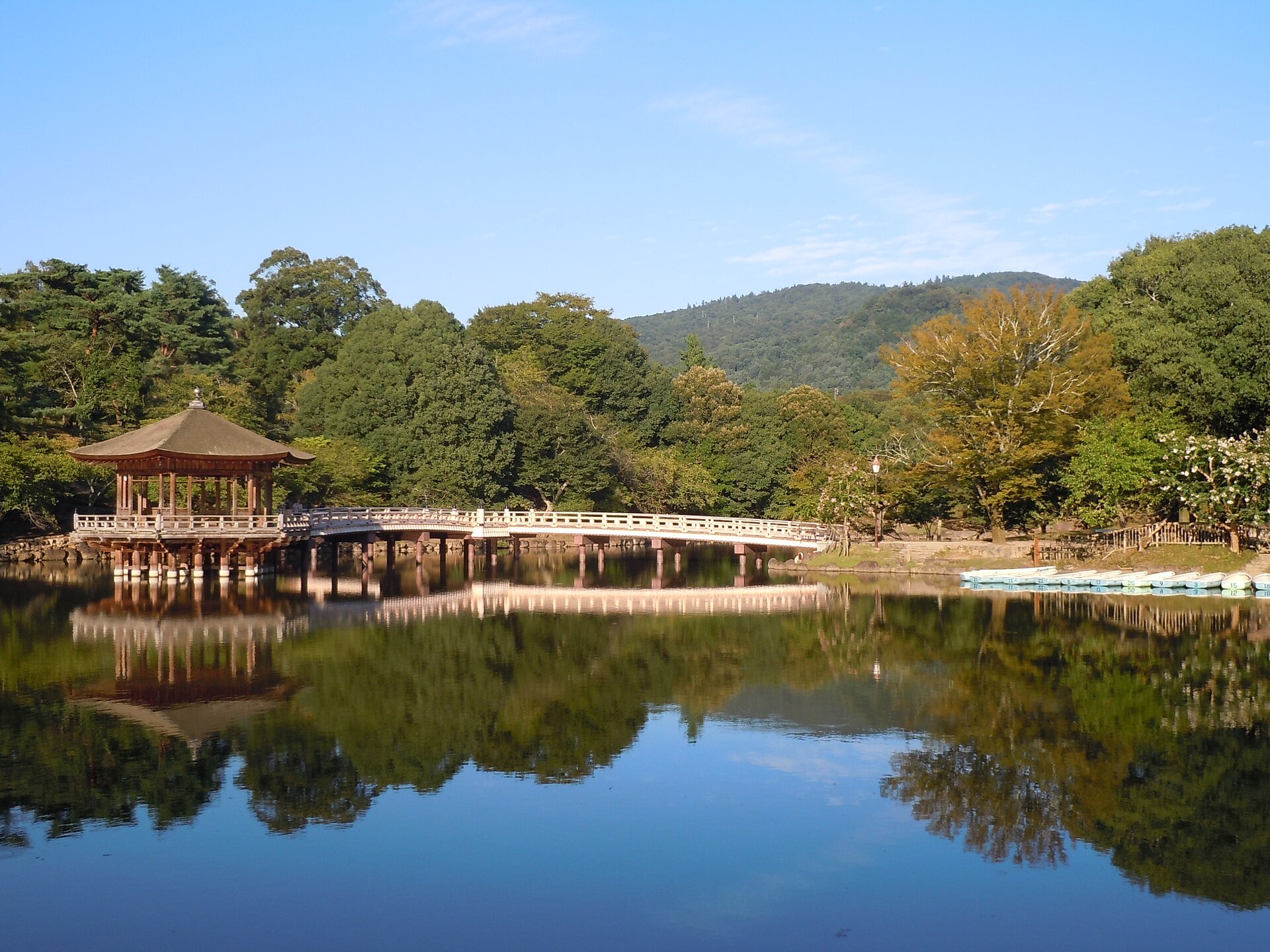
Nara Park is not a single attraction but a composite of several distinct zones. Tobihino, a large grassy meadow at the center of the park, is one of the spots where deer tend to gather most. The sight of a herd of deer crossing through the morning mist has been captured in countless photographs as one of the defining images of Nara Park. Ukimido is a hexagonal floating pavilion on Sagi Pond, offering a tranquil view created by the surrounding greenery and the still water's surface. On the eastern edge of the park, Mt. Wakakusa (342 meters above sea level) is a gently sloping, triple-tiered hill blanketed in turf, offering a panoramic view of Nara City and the Osaka Plain from the summit. The "Yamayaki" (Mountain Burning) held every January, in which the entire mountain is set ablaze, is a dramatic winter tradition. Mt. Wakakusa is open to visitors for a limited period each year, and a separate entry fee is required. With fresh greenery in spring, blue skies in summer, the combination of autumn foliage and deer, and the Mountain Burning in winter, Nara Park reveals a different side of itself with every season—and that depth is part of what makes it so rewarding.

How this character would spend the day
Kenta's Recommended Route (Family Outing Course)
- 9:00Arrive at Kintetsu Nara Station. Walk about 8 minutes to the park. First thing in the morning, before the crowds arrive, is the right call.
- 9:15Head to the Tobihino grass meadow. Buy some deer crackers and interact with the deer. Since the park itself is free, you've made it this far on just transportation costs—easy on the wallet.
- 10:30Move on to Todai-ji's Great Buddha Hall. A separate admission fee is required, but the 15-meter Great Buddha is something every kid should see at least once. It's so big it won't fit in a smartphone photo.
- 12:00Lunch at one of the dining spots near the Great Buddha Hall. Take your time browsing the souvenir shops and enjoy a leisurely break.
- 13:30Visit Kasuga Taisha. Walk through the stone lantern-lined approach to the main shrine. After all that walking, there's a real sense of accomplishment when you arrive. Then head back to Kintetsu Nara Station for the journey home.